
Family Hubs


“The best remedy for those who are afraid, lonely or unhappy is to go outside.” – Anne Frank
Spending time outdoors is great for your body and mind! It can improve your mood, reduce feelings of stress, improve your confidence, helps you to be more active and can reduce loneliness.
How to get outside more:
It can be helpful to get outdoors every day, even if only for a short time. You could try walking to a friend’s house or to the shop instead of travelling by car or getting public transport. You could try to make getting outside part of your daily routine, whether it is riding a bike or sitting in a garden or park while you listen to music.
Please contact [email protected] for information and advice about mental health and well-being for your child and your family.
“Mistakes are proof that you are trying.” – Unknown
Throughout our lives we are going to experience different challenges, both big and small. There will be times where these challenges are exciting and maybe other times where challenges could feel scary and uncertain. These different challenges will push us to try new things, build our resilience and teach us new things about ourselves and the world around us.
When taking on challenges, we learn that we can work towards goals, overcome any obstacles and be resilient even when something is difficult. A growth mindset can help us take on new challenges, it builds our confidence to have a go at things, increases our self-esteem and encourages us to keep trying, even if something doesn’t work out the first time!
Our top tips for challenging ourselves:
ThanksKids recognises the efforts and kindness of children and young people, and thanks them with personalised #NHSStars certificates. If you know a child or young person that deserves recognition for going above and beyond, don’t wait, nominate! [email protected].
Please contact [email protected] for information and advice about mental health and well-being for your child and your family.

“If it makes you happy, do more of that.” – Unknown
Self-care is all about the little things we do to help ourselves feel better or to keep ourselves feeling
good. This is a great way to look after our mental health and wellbeing. Self-care involves ‘checking
in’ with yourself and thinking “how do I feel today?” and understanding “what do I need today?” Self-care looks different for everybody. What works for one person may not work for someone else!
Our tips for self-care:
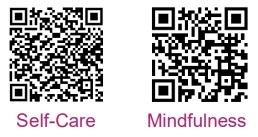
Make time for a relaxation activity. Scan the QR codes, or clink on the links below for more information around self-care. Why not try the mindfulness activities in the QR codes below too:
Please contact [email protected] for information and advice about mental health and well-being for your child and your family.
Dimensions Tool
Follow this link for free online personalised self-care information and support for adults and children in Coventry and Warwickshire.
“Let food be thy medicine and thy medicine shall be thy food.” – Hippocrates
Nutrition refers to the nutrients in food and how our body uses them to stay strong and healthy. There are lots of positive benefits for our physical health, nutrition is also really important for our mental health!
Our brain works hard taking care of our thoughts, movements, breathing, heartbeat and senses (even when we are sleeping!), so we must fuel our brain with nutritious foods to help us function. This can help us to think clearly, increase our energy levels and support concentration. What we eat also affects our mood too!
Our tips:
Please contact [email protected] for information and advice about mental health and well-being for your child and your family.
“Time you enjoy wasting is not wasted time.” – Unknown
Relaxation is when our mind and body is free from stress and tension. Research has found that this can help us to think clearly, concentrate, sleep well, feel more confident and even boost our immune system!
Relaxation can look different for everyone, and it can be helpful to try a few different relaxation techniques to see what works best to make you feel happy and rested.
Our Tips for Relaxation:
1- Try some breathing exercises, such as finger breathing or square breathing. Breathing exercises are great as you can do them in any place, at any time. Follow the link to try flower and candle breathing!
2- Drawing or colouring can help you to express your feelings and focus on something peaceful. This is a great way to relax your mind!
3- Practice mindfulness by taking a break away from any screens and devices. This could be going on a walk or being outside in nature. Try to use as many of your senses as possible, think about what you can see, hear, smell, touch and even taste! You could even try cloud watching to calm your mind.
4- Stretch it out, practice yoga to stretch out your muscles to relax and reduce tension. Try following the link for a yoga video!
5- A warm bath or shower can be a soothing experience that helps to relax muscles and calm your mind. You could make it extra relaxing with quiet music and bubbles!
Please contact [email protected] for information and advice about mental health and well-being for your child and your family.
“We carry with us, as human beings, not just the capacity to be kind, but the very choice of kindness.” – R.J. Palacio
Kindness means being friendly, generous, and considerate to others. It’s all about showing care and respect through our actions and our words.
Random Acts of Kindness Day is celebrated each year on February 17th, however you can practice random acts of kindness all year round
Here are some easy ideas to spread kindness:
Why is being kind important?
Kindness is contagious! When you show kindness, it inspires others to do the same. When you are kind to someone, it can help them to feel happy, it can brighten their day and boost their mood.
Kindness can help to make schools, homes and communities more welcoming and friendly. When people are kind, everyone feels more comfortable which can lead to better relationships and friendships.
Please contact [email protected] for information and advice about mental health and well-being for your child and your family.
Tips for wellness from our Mental Health In Schools Team
“You’ll never find a rainbow if you’re looking down” – Charlie Chaplin
Our mood can change, and this is completely normal. You may notice that sometimes you are feeling more tired than usual, maybe stressed or experiencing difficulties with schoolwork or friendships. Situations like these may cause you to feel a bit low, it can be really helpful to talk about these things with an adult, or someone you trust.
Whilst it is normal to feel this way at times, there are things we can do to boost our mood and help us to feel happier. By doing more of the things we love and value, or ‘doing more of what matters’, we can boost our mood. This helps us to feel less tired, have an increased sense of achievement, feel better about ourselves and have some fun!
Our tips for boosting your mood:
Please contact [email protected] for information and advice about mental health and well-being for your child and your family.
“Live as if you will die tomorrow. Learn as if you will live forever.” – Mahatma Gandhi
We are always learning new things – often without realising it! Learning can include developing skills as well as developing knowledge. Learning something new can help to improve our mental wellbeing, as it gives us a sense of achievement and purpose. We can challenge ourselves to build new skills or develop skills that we already have. It can help to build motivation, confidence, and self-esteem too.
To help us to learn something new, we can set ourselves a challenge or a goal to work towards. Can you think of a new challenge or goal to try?
Learning can be fun! Studies show that learning can help us to enjoy life more! Can you find a new activity that you enjoy and make it part of your life?
Our tips for learning:
Please contact [email protected] for information and advice about mental health and well-being for your child and your family.